Two prayer apps in the same city can disagree by several minutes, sometimes more for Fajr and Isha. That is not a bug: they are using different calculation methods. Here is what those methods mean and how to choose.
Dhuhr and Maghrib are the easy ones
Dhuhr begins just after the sun passes its highest point, and Maghrib at sunset. Every method agrees on these, give or take a minute or two of safety margin.
Fajr and Isha depend on twilight
Fajr begins at true dawn and Isha when twilight has gone. Astronomers measure both by how far the sun is below the horizon. Methods differ on the angle: the Muslim World League uses 18° for Fajr and 17° for Isha, ISNA uses 15° for both, Umm al-Qura uses 18.5° for Fajr and a fixed 90 minutes after Maghrib for Isha, and the University of Islamic Sciences, Karachi uses 18° for both.
A larger angle means an earlier Fajr and a later Isha. In high latitudes in summer the sun may never go deep enough, which is why some regions use special rules.
Hanafi and standard Asr
Asr begins when an object's shadow reaches a certain length. In the standard (Shafi'i, Maliki and Hanbali) view, that is the object's length plus its shadow at noon. In the Hanafi view it is twice the object's length plus its noon shadow, so Hanafi Asr is later, often by 45 minutes to an hour.
Which method should you use?
Use the method your local masjid uses, so that your times match the jama'ah. As a rough guide: Pakistan, India and Bangladesh usually follow Karachi with Hanafi Asr; Saudi Arabia, Umm al-Qura; North America, ISNA or the Moonsighting Committee; Turkey, Diyanet; and many UK and European masajid, the Muslim World League or the Moonsighting Committee.
- Check your masjid's printed timetable
- Pick the method that matches most prayers
- Nudge any prayer by a few minutes to match exactly
In Quran Mushaf
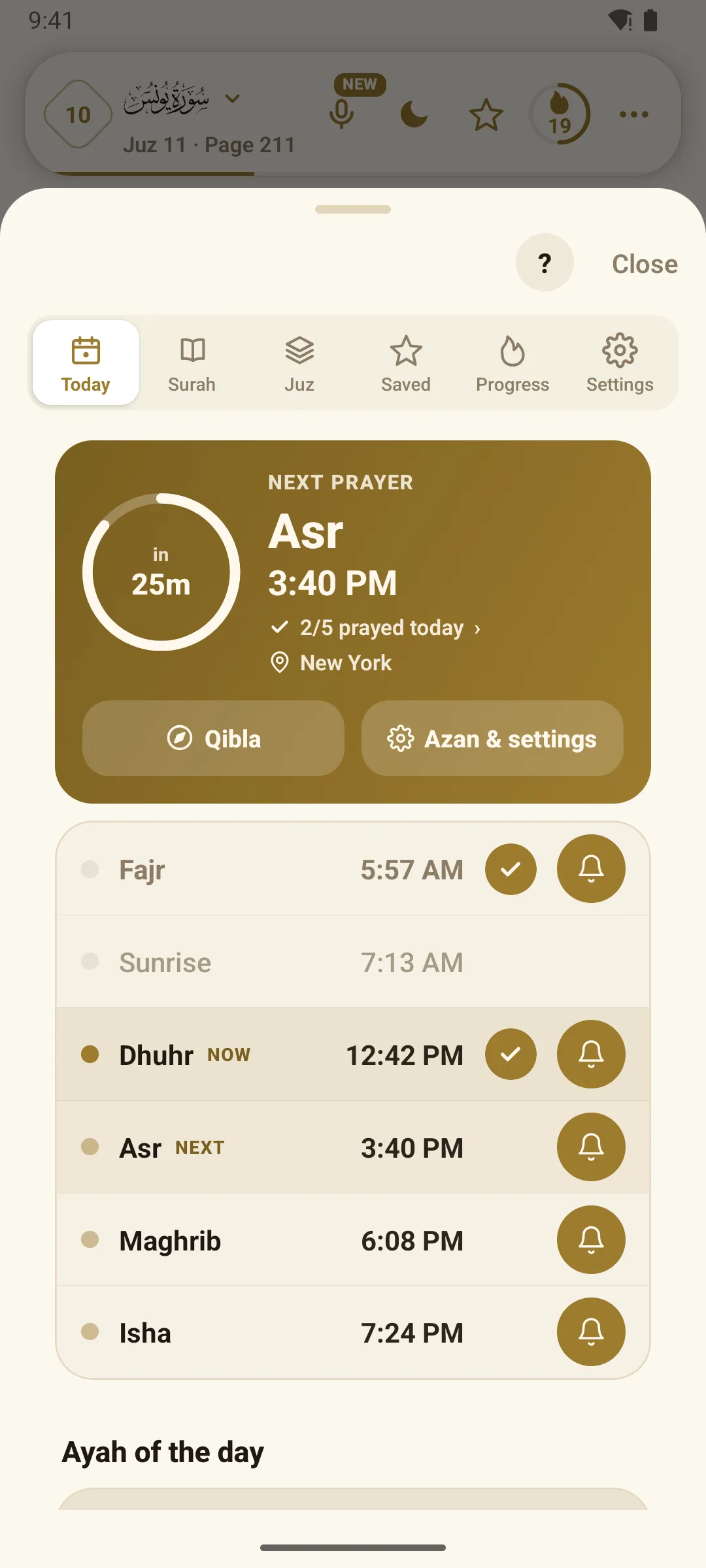
Quran Mushaf calculates times on your phone with 12 methods, lets you choose Hanafi or standard Asr, and adjust each prayer by minutes. Your approximate location stays on your phone.